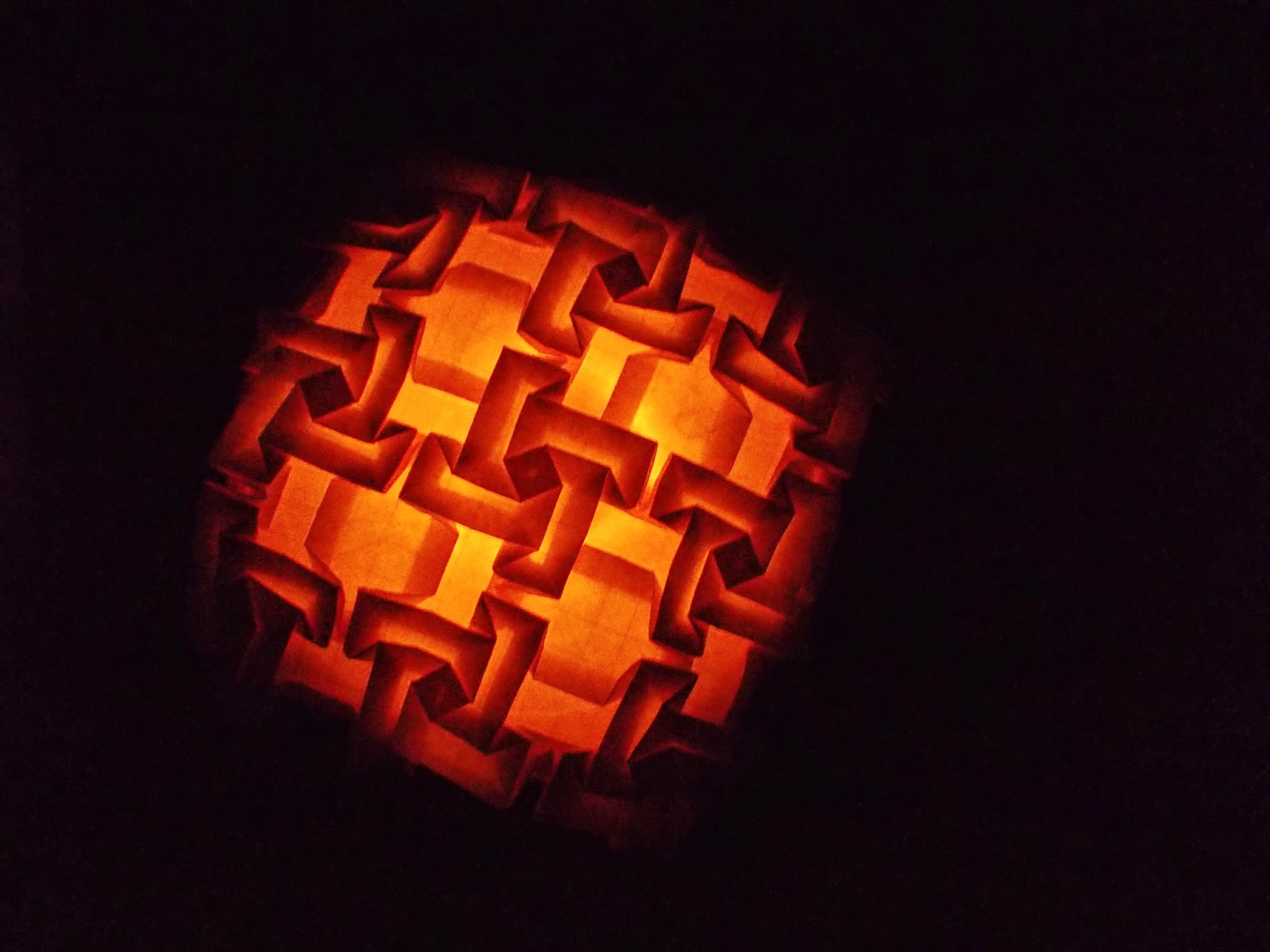
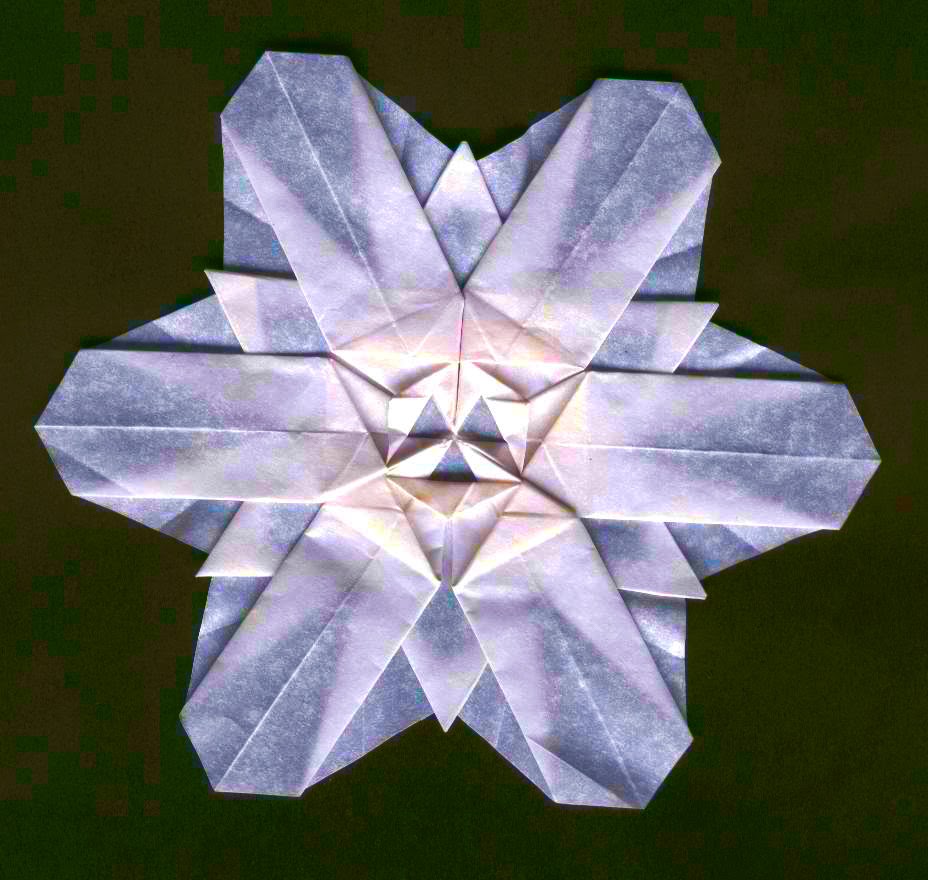
This is the Fuufuki Asagao Kuduama designed by Tomoko Fuse. The diagrams can be found in Fuse's book "Unit Origami Fantasy".
The kusudama looks very cute at first glance. It looks also very clean and simple. But, a very big problem about this model is the locking mechanism. Expect that you will have lots of trouble assembling the model since the units separate very easily.
It also is fragile unlike other kusudamas. Just after examining the photos I took below, I turn around and BAM! the kusudama is on the floor and in pieces. It was the third time it shattered into the 30 units that make up the model. I had to resort to using glue to make the model sturdy, and every origami artist knows that GLUING is a mortal sin in the divine laws of origami...
But anyways, it is still a cute model, and it is my second legit kusudama after folding Sinayskaya's Stilleto Star for the 2014 International Origami Internet Olympiad.
Happy New Year!
-ABonymous-
Wednesday, December 31, 2014
Tuesday, December 30, 2014
Flower Tower
This is a design by Chris Palmer. Jeremy Shafer posted a tutorial of this model on Youtube with the teacher being Chris Palmer himself.
Do you experience situations where you do not have the required size of paper for a model so you just have to be content about using a smaller sheet and therefore having a smaller-than-normal product? That is what I felt...The model really consumes paper when it comes to size and I only have a square piece at least 8.5 inches on each side. I really needed the metal stick mail opener I bought from S. Korea to finish the top layer.
If you want a model with many more layers, it's best to use paper with dimensions 12 inches x 12 inches or larger. Just imagine the 8.5 inch x 8.5 inch paper I used shrunk to a mere approximately 2 inches of diameter.
The usual Flower Tower starts from a dodecahedron base (the paper can still be square) but there are other versions, with models folded from octagon-based folds, and even hexagon and pentagon bases.
What stands out with this model is that it has different firework-like layers than can jut out and flatten when folded correctly. It is not an easy model, though. The squishing of the cylinder-like structure midway through the process can also be difficult unless the folds were done accurately or properly.
Happy New Year!
-ABonymous-
Do you experience situations where you do not have the required size of paper for a model so you just have to be content about using a smaller sheet and therefore having a smaller-than-normal product? That is what I felt...The model really consumes paper when it comes to size and I only have a square piece at least 8.5 inches on each side. I really needed the metal stick mail opener I bought from S. Korea to finish the top layer.
If you want a model with many more layers, it's best to use paper with dimensions 12 inches x 12 inches or larger. Just imagine the 8.5 inch x 8.5 inch paper I used shrunk to a mere approximately 2 inches of diameter.
The usual Flower Tower starts from a dodecahedron base (the paper can still be square) but there are other versions, with models folded from octagon-based folds, and even hexagon and pentagon bases.
What stands out with this model is that it has different firework-like layers than can jut out and flatten when folded correctly. It is not an easy model, though. The squishing of the cylinder-like structure midway through the process can also be difficult unless the folds were done accurately or properly.
Happy New Year!
-ABonymous-
Regal Tessellation
Wow...I missed designing tessellations! So, just after Christmas I made the Regal Tessellation.
I decided to name it "Regal" since I see many patterns like these on crowns, royal garments, and others.
It is folded from somewhat construction-like yellow paper with a grid of 32 by 32.
I also have a gift for all of you! A Christmas-New Year gift!
I really hope the crease pattern is understandable. It's difficulty is intermediate, though it is not the simple "pleat-twist" like tessellation.
Happy Holidays!
I decided to name it "Regal" since I see many patterns like these on crowns, royal garments, and others.
It is folded from somewhat construction-like yellow paper with a grid of 32 by 32.
I also have a gift for all of you! A Christmas-New Year gift!
I really hope the crease pattern is understandable. It's difficulty is intermediate, though it is not the simple "pleat-twist" like tessellation.
Happy Holidays!
Wednesday, December 24, 2014
Christmas Tree
It's already December 24! The next day will be Christmas, so...
This is an origami Christmas Tree designed by Francesco Guarnieri. The diagrams are in http://guarnieri-origami.blogspot.it/2012/11/bialbero-di-natale-multialbero.html with additional clues for instruction at http://goorigami.com/modular-origami/origami-christmas-tree/1960 .
It is a multi-piece origami model which will lovely sit on your table during the holidays! (or any time if it is your "trip"). Why did I say "multi-piece" not modular? A multi-piece model is made of more than one piece of paper. A modular model us a subcategory of the multi-piece model wherein the units of the model are the same. This Christmas tree, although it has units similar to each other, the sizes are quite different (difference: at least 2 cm).
Merry Christmas to all of you!
-ABonymous=
1
This is an origami Christmas Tree designed by Francesco Guarnieri. The diagrams are in http://guarnieri-origami.blogspot.it/2012/11/bialbero-di-natale-multialbero.html with additional clues for instruction at http://goorigami.com/modular-origami/origami-christmas-tree/1960 .
It is a multi-piece origami model which will lovely sit on your table during the holidays! (or any time if it is your "trip"). Why did I say "multi-piece" not modular? A multi-piece model is made of more than one piece of paper. A modular model us a subcategory of the multi-piece model wherein the units of the model are the same. This Christmas tree, although it has units similar to each other, the sizes are quite different (difference: at least 2 cm).
Merry Christmas to all of you!
-ABonymous=
Tuesday, December 23, 2014
Wreath
2
This is an origami (Christmas?) wreath designed by Darren Scott, with diagrams published in Everything Origami (Gardiner).
This model, containing 6 units, is actually very easy to create (if you see the diagrams...it is easy to reverse-engineer this model though). Make lots of it and use it to decorate your home! (Make sure to use red and green paper for this model to create a "Christmas theme" with this model.)
Happy Holidays!
-ABonymous-
Monday, December 22, 2014
Snowflake v. 2
3
Sorry that I am featuring a snowflake again for this countdown, but the original model got destroyed by accident and I have to make a new one for just a short period of time. Anyways, it is still related to Christmas. This particular snowflake model, designed by Joseph Wu, resembles less of the stereotypical snowflake than the one in the previous post (d. b. Walker) but it's still pretty, nevertheless. Remember the fact that every (real) snowflake is unique, and no two snowflakes are exactly alike! Surely there's a snowflake that resembles this pattern, right? I think I saw one on Google.
This model is one of the "looks best with translucent paper" type.
I am honest to say that there are tricky parts in making this model...well probably because I used parchment paper again. I have not bought tracing paper yet and I am still counting the seconds until I get to buy tracing paper. Well I still have yet to post a back lighted photo of this model for a stupid reason...hopefully I will be able to post it tomorrow...
Here are the diagrams to the model (c. 1997) http://www.josephwu.com/Files/PDF/snowflake.pdf
I've featured 2 types of origami snowflakes here already on Yey! Origami....go use them and decorate your rooms and houses!
Happy Holidays!
-ABonymous-
Sunday, December 21, 2014
Snowflake
4
This is designed by Dennis Walker, with diagrams found in:
http://www.prospero78.freeserve.co.uk/diagrams/snowflake1.gif
http://www.prospero78.freeserve.co.uk/diagrams/snowflake2.gif
with video tutorial by Sara Adams in happyfolding.com
This is a very nice decoration to garnish your home or gifts with in the holidays! (Too bad it does not snow where I live, though. Crap.) The best paper to use in this model is semi-translucent paper (like tracing paper, if your tracing paper is not like what I have here which is so hard to cut and make genderless folds with). Make sure to use paper not TOO thin, but not TOO thick either. There are parts where the model gets too stuffy to fold, and parts where it's vulnerable to ripping its ass off. Even though it looks complex, it is actually easy to intermediate, I guess.
Well, since I cannot find my tracing paper (how many days did I not post?) I used the closest kind to tracing paper: Parchment. It is the type of paper used for the diplomas you love so much and hang it on your favorite wall spot. The paper in the photos above is Parchment. But, as you can see, the pattern is not really evident even when backed up with black paper. When you use tracing paper, it will show more. (I should have bought some, but right now I'm busy buying gifts for my friends...especially the demanding witches...).
Merry Christmas, and Happy Holidays!
-ABonymous-
Subscribe to:
Posts (Atom)