Tuesday, April 28, 2015

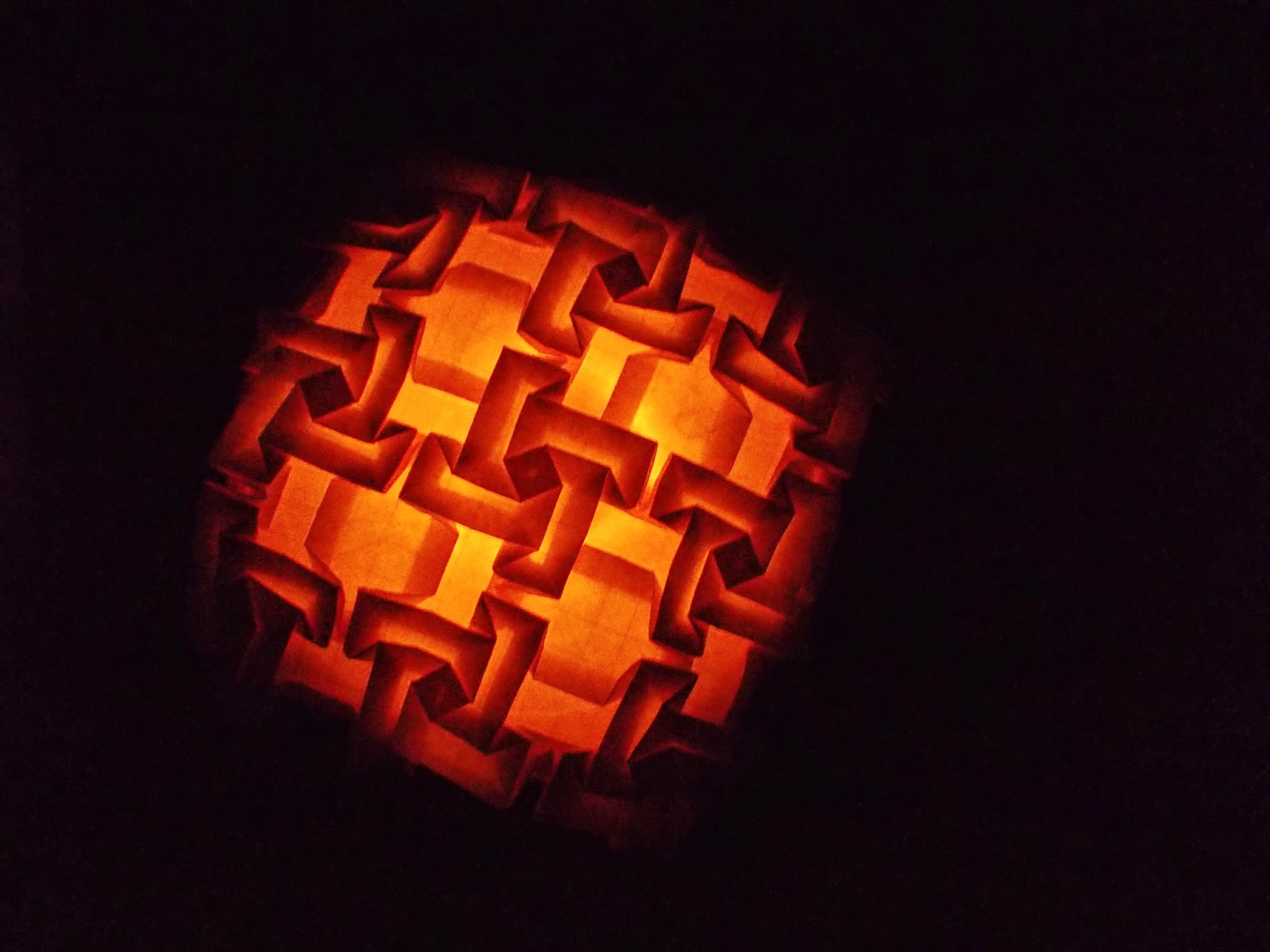
Weaved Ball

Name
 Weaved Ball
Designer
 Toshikazu Kawasaki   かわさき  としかず
Level of Difficulty (5x ☻= very difficult )
(Based on opinions of different artists)
 ☻☻☻
Type (According to Number of Sheets Used)
Multi-Piece, Modular
Number of Sheets / Units
 12 Units
Type (According to Object being Presented)
 Geometric
Diagrams
 Book - Greatest Dream Origami (Kawasaki)
Video Tutorial
 ---

This is a wonderful design by Toshikazu Kawasaki. The 12 long units are arranged in a way that they form the edges of an octahedron (polyhedron with 8 (equilateral) triangular sides) with the "spirals" forming the vertices of the polyhedron.

When folding the units, be careful for there are some points that are very vulnerable to ripping.


Star Holes Kusudama


Name
 Star Holes
Designer
 Francesco Mancini
Level of Difficulty (5x ☻very difficult= )
(Based on opinions of different artists)
 ☻☻☻
Type (According to Number of Sheets Used)
 Multi-Piece, Modular
Number of Sheets / Units
 30 Units
Type (According to Object being Presented)
 Geometric, Kusudama (Flower Ball)
Diagrams
 ---
Video Tutorial


This is a lovely Kusudama design by Mancini from Italy. It got the rank "Intermediate" probably because of the great number of units to be used. What is just needed here is patience and eagerness to finish the model, since the units are very easy to create.
Unlike many Kusudamas I have attempted to fold, this one has a very good lock mechanism that does not need glue for the units to hold each other together.
There is also a similar model (also designed by Mancini) that looks very similar with this Kusudama. The Star Dodecahedron has thinner units and looks more like a wireframe. The video tutorial can be found here.

P.S. It is so good to be back! I know that this post, this post I wrote on April 28, 2015, is the very first blog post I have done for this year. The last few school weeks have been hectic, but I have finally graduated high school in March! In April, some weeks were also hectic due to some exhibits and issues with Heritage Conservation in my country (an unrelated topic. I might write it in Ligaya sa Lakbay). A few minutes earlier I was reading my earlier blog posts and I am honest to say I vomited on how corny my earlier posts are... Anyways, I will try to make up for lost time. It is good to be back. :)

Wednesday, December 31, 2014

Yey! Origami Timeline: Year-End Review (2014)

Yey! Origami
January 17: Fish (Vinko)
January 30: Crease Pattern for Flowing Rivers Tessellation (My Design)
February 13: Smart Waterbomb (Chapman-Bell)
February 14: Geometric Flower (Guarnieri)
February 22: Star Doris (Ennen), Butterfly (Giunta)
March 21: Snail (Komatsu)
April 3: Pelleas Box (Keller)
April 12: Spring Into Action (Beynon)
April 30: Nobuko's Puff Ring / December Decoration (Okabe, Meeusen)
May 17: Starry Fields Tessellation (Manaois)
July 11: Tarantula (Lang)
July 12: Geometric Bird (Diaz)
September 19: Beetle (Nakashima)
October 25: 12-Point Star (Keller)
December 15: Stella Pitti (Mancini)
December 16: Stern Franziska (Sprung)
December 17: Stern Clarissa (Sprung)
December 18: Sonobe Polyhedra (Sonobe)
December 19: Pine Cone (Petty)
December 20: Flower For Rose (Scott)
December 21: Snowflake (Walker), Origami A Day changes name to Yey! Origami
December 22: Snowflake (Wu)
December 23: Wreath (Scott)
December 24: Christmas Tree (Guarnieri)
December 30: Regal Tessellation (My Design), Flower Tower (Palmer)
December 31: Fuufuki Asagao Kusudama (Fuse), Year Review (THIS POST)

HAPPY NEW YEAR TO ALL!!! 
-ABonymous-

ふうふき あさがお くすだま

This is the Fuufuki Asagao Kuduama designed by Tomoko Fuse. The diagrams can be found in Fuse's book "Unit Origami Fantasy".

The kusudama looks very cute at first glance. It looks also very clean and simple. But, a very big problem about this model is the locking mechanism. Expect that you will have lots of trouble assembling the model since the units separate very easily.

It also is fragile unlike other kusudamas. Just after examining the photos I took below, I turn around and BAM! the kusudama is on the floor and in pieces. It was the third time it shattered into the 30 units that make up the model. I had to resort to using glue to make the model sturdy, and every origami artist knows that GLUING is a mortal sin in the divine laws of origami...

But anyways, it is still a cute model, and it is my second legit kusudama after folding Sinayskaya's Stilleto Star for the 2014 International Origami Internet Olympiad.


Happy New Year!
-ABonymous-

Tuesday, December 30, 2014

Flower Tower

This is a design by Chris Palmer. Jeremy Shafer posted a tutorial of this model on Youtube with the teacher being Chris Palmer himself.

Do you experience situations where you do not have the required size of paper for a model so you just have to be content about using a smaller sheet and therefore having a smaller-than-normal product? That is what I felt...The model really consumes paper when it comes to size and I only have a square piece at least 8.5 inches on each side. I really needed the metal stick mail opener I bought from S. Korea to finish the top layer.


If you want a model with many more layers, it's best to use paper with dimensions 12 inches x 12 inches or larger. Just imagine the 8.5 inch x 8.5 inch paper I used shrunk to a mere approximately 2 inches of diameter.

The usual Flower Tower starts from a dodecahedron base (the paper can still be square) but there are other versions, with models folded from octagon-based folds, and even hexagon and pentagon bases.

What stands out with this model is that it has different firework-like layers than can jut out and flatten when folded correctly. It is not an easy model, though. The squishing of the cylinder-like structure midway through the  process can also be difficult unless the folds were done accurately or properly.

Happy New Year!

-ABonymous-

Regal Tessellation

Wow...I missed designing tessellations! So, just after Christmas I made the Regal Tessellation.
I decided to name it "Regal" since I see many patterns like these on crowns, royal garments, and others.


It is folded from somewhat construction-like yellow paper with a grid of 32 by 32.
I also have a gift for all of you! A Christmas-New Year gift!

I really hope the crease pattern is understandable. It's difficulty is intermediate, though it is not the simple "pleat-twist" like tessellation.

Happy Holidays!

Wednesday, December 24, 2014

Christmas Tree

It's already December 24! The next day will be Christmas, so...
 1

This is an origami Christmas Tree designed by Francesco Guarnieri. The diagrams are in http://guarnieri-origami.blogspot.it/2012/11/bialbero-di-natale-multialbero.html with additional clues for instruction at http://goorigami.com/modular-origami/origami-christmas-tree/1960 .

It is a multi-piece origami model which will lovely sit on your table during the holidays! (or any time if it is your "trip"). Why did I say "multi-piece" not modular? A multi-piece model is made of more than one piece of paper. A modular model us a subcategory of the multi-piece model wherein the units of the model are the same. This Christmas tree, although it has units similar to each other, the sizes are quite different (difference: at least 2 cm).

Merry Christmas to all of you!

-ABonymous=

Related Posts Plugin for WordPress, Blogger...