Showing posts with label Other Geometric Figures. Show all posts

Tuesday, April 28, 2015

Weaved Ball

Name
 Weaved Ball
Designer
 Toshikazu Kawasaki   かわさき  としかず
Level of Difficulty (5x ☻= very difficult )
(Based on opinions of different artists)
 ☻☻☻
Type (According to Number of Sheets Used)
Multi-Piece, Modular
Number of Sheets / Units
 12 Units
Type (According to Object being Presented)
 Geometric
Diagrams
 Book - Greatest Dream Origami (Kawasaki)
Video Tutorial
 ---

This is a wonderful design by Toshikazu Kawasaki. The 12 long units are arranged in a way that they form the edges of an octahedron (polyhedron with 8 (equilateral) triangular sides) with the "spirals" forming the vertices of the polyhedron.

When folding the units, be careful for there are some points that are very vulnerable to ripping.


Star Holes Kusudama


Name
 Star Holes
Designer
 Francesco Mancini
Level of Difficulty (5x ☻very difficult= )
(Based on opinions of different artists)
 ☻☻☻
Type (According to Number of Sheets Used)
 Multi-Piece, Modular
Number of Sheets / Units
 30 Units
Type (According to Object being Presented)
 Geometric, Kusudama (Flower Ball)
Diagrams
 ---
Video Tutorial


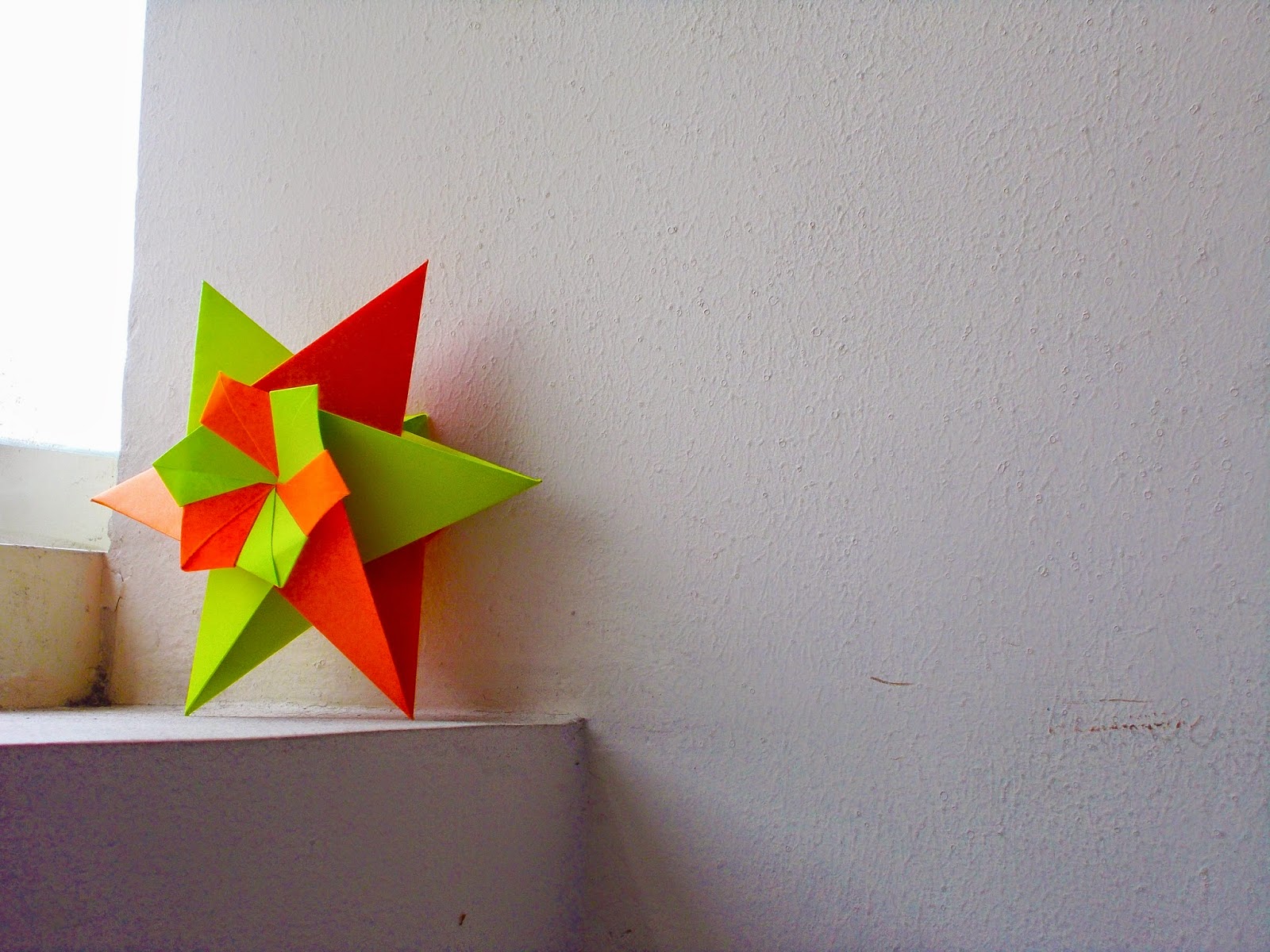
This is a lovely Kusudama design by Mancini from Italy. It got the rank "Intermediate" probably because of the great number of units to be used. What is just needed here is patience and eagerness to finish the model, since the units are very easy to create.
Unlike many Kusudamas I have attempted to fold, this one has a very good lock mechanism that does not need glue for the units to hold each other together.
There is also a similar model (also designed by Mancini) that looks very similar with this Kusudama. The Star Dodecahedron has thinner units and looks more like a wireframe. The video tutorial can be found here.

P.S. It is so good to be back! I know that this post, this post I wrote on April 28, 2015, is the very first blog post I have done for this year. The last few school weeks have been hectic, but I have finally graduated high school in March! In April, some weeks were also hectic due to some exhibits and issues with Heritage Conservation in my country (an unrelated topic. I might write it in Ligaya sa Lakbay). A few minutes earlier I was reading my earlier blog posts and I am honest to say I vomited on how corny my earlier posts are... Anyways, I will try to make up for lost time. It is good to be back. :)

Tuesday, December 30, 2014

Flower Tower

This is a design by Chris Palmer. Jeremy Shafer posted a tutorial of this model on Youtube with the teacher being Chris Palmer himself.

Do you experience situations where you do not have the required size of paper for a model so you just have to be content about using a smaller sheet and therefore having a smaller-than-normal product? That is what I felt...The model really consumes paper when it comes to size and I only have a square piece at least 8.5 inches on each side. I really needed the metal stick mail opener I bought from S. Korea to finish the top layer.


If you want a model with many more layers, it's best to use paper with dimensions 12 inches x 12 inches or larger. Just imagine the 8.5 inch x 8.5 inch paper I used shrunk to a mere approximately 2 inches of diameter.

The usual Flower Tower starts from a dodecahedron base (the paper can still be square) but there are other versions, with models folded from octagon-based folds, and even hexagon and pentagon bases.

What stands out with this model is that it has different firework-like layers than can jut out and flatten when folded correctly. It is not an easy model, though. The squishing of the cylinder-like structure midway through the  process can also be difficult unless the folds were done accurately or properly.

Happy New Year!

-ABonymous-

Tuesday, December 23, 2014

Wreath

2


This is an origami (Christmas?) wreath designed by Darren Scott, with diagrams published in Everything Origami (Gardiner).

This model, containing 6 units, is actually very easy to create (if you see the diagrams...it is easy to reverse-engineer this model though). Make lots of it and use it to decorate your home! (Make sure to use red and green paper for this model to create a "Christmas theme" with this model.)

Happy Holidays!

-ABonymous-

Monday, December 22, 2014

Snowflake v. 2

3
Sorry that I am featuring a snowflake again for this countdown, but the original model got destroyed by accident and I have to make a new one for just a short period of time. Anyways, it is still related to Christmas. 

This particular snowflake model, designed by Joseph Wu, resembles less of the stereotypical snowflake than the one in the previous post (d. b. Walker) but it's still pretty, nevertheless. Remember the fact that every (real) snowflake is unique, and no two snowflakes are exactly alike! Surely there's a snowflake that resembles this pattern, right? I think I saw one on Google.

This model is one of the "looks best with translucent paper" type.

I am honest to say that there are tricky parts in making this model...well probably because I used parchment paper again. I have not bought tracing paper yet and I am still counting the seconds until I get to buy tracing paper. Well I still have yet to post a back lighted photo of this model for a stupid reason...hopefully I will be able to post it tomorrow...

Here are the diagrams to the model (c. 1997) http://www.josephwu.com/Files/PDF/snowflake.pdf

I've featured 2 types of origami snowflakes here already on Yey! Origami....go use them and decorate your rooms and houses! 

Happy Holidays!

-ABonymous-

Sunday, December 21, 2014

Snowflake

4

This is designed by Dennis Walker, with diagrams found in:

http://www.prospero78.freeserve.co.uk/diagrams/snowflake1.gif
http://www.prospero78.freeserve.co.uk/diagrams/snowflake2.gif

with video tutorial by Sara Adams in happyfolding.com

This is a very nice decoration to garnish your home or gifts with in the holidays! (Too bad it does not snow where I live, though. Crap.) The best paper to use in this model is semi-translucent paper (like tracing paper, if your tracing paper is not like what I have here which is so hard to cut and make genderless folds with). Make sure to use paper not TOO thin, but not TOO thick either. There are parts where the model gets too stuffy to fold, and parts where it's vulnerable to ripping its ass off. Even though it looks complex, it is actually easy to intermediate, I guess.

Well, since I cannot find my tracing paper (how many days did I not post?) I used the closest kind to tracing paper: Parchment. It is the type of paper used for the diplomas you love so much and hang it on your favorite wall spot. The paper in the photos above is Parchment. But, as you can see, the pattern is not really evident even when backed up with black paper. When you use tracing paper, it will show more. (I should have bought some, but right now I'm busy buying gifts for my friends...especially the demanding witches...).

Merry Christmas, and Happy Holidays!

-ABonymous-


Saturday, December 20, 2014

Flower For Rose

5


This is the "Flower for Rose" designed by Darren Scott with diagrams found in "Everything Origami" (Matthew Gardiner). In my place it is somehow reminiscent of a type of Capiz-made lanterns (Capiz lanterns are shaped like stars supplied with lights that blink with a light interval, forming different light patterns). It is also somehow almost a common design in greeting cards.

Happy Holidays!

-ABonymous-

Friday, December 19, 2014

Pine Cone

6

Good evening! This is an origami Pine Cone designed by David Petty (RIP). I decided to put this in the list since (where I live) pine cones are frequent decorations in Christmas occasions. In my place, the townsfolk paint the cones, stick them with mistletoe leaves and berries, and tie them around the house, with wreaths, or use them as a bouquet for a centerpiece of a table. But there's one problem: there are no pine trees in my place, which is tropical. The only good place for pine trees to grow is in Baguio City, a city way up in the mountains.

So, I decided to include this in the list since people who live in tropical areas can make such models without toiling to get some in the temperate regions (but anyone can still make it!). It's a pretty simple model, with a video tutorial done by Origami Nut (http://www.origaminut.com/58/pine-cone) with diagrams at http://www.davidpetty.me.uk/petty_work/pcone1.htm.But, I guess it's still ok to buy some, right? :D

Merry Christmas and Happy New Year!

-ABonymous-


Wednesday, December 17, 2014

Star Clarissa

8


This is Star Clarissa or Stern Clarissa (German) design by Carmen Sprung with diagrams in Origami: 21 Sterne.

The model uses 8 units, and is a GREAT model for Christmas! Use Christmas-themed colors (like red and green) on paper and make them into a wreath!
Happy Holidays!
-ABonymous

Tuesday, December 16, 2014

Star Franziska

9


Now the 9th model for our countdown: Franziska Star or Stern Franziska, designed by Carmen Sprung with diagrams published in "Origami: 21 Sterne".
The star in the photos is made from 6 units. You may choose from 5 to 8 units. (I just find the 6-unit star cute...hahaha)

Monday, December 15, 2014

Stella Pitti

PS Note: It has already been a LONG TIME ever since I have posted :P Here is why:
1. Me and my group mates went to Japan to participate in the 2014 Asian International Children's Film Festival to present the Philippines (our film was chosen and it was a privilege!)
2. My pointing finger of my right hand got rotten on the upper part and I had it operated on. Right now I am still taking medications. (It was painful as hell...but of course not as painful as giving birth to a donkey...maybe).

3. SCHOOLWORKS and ASSIGNMENTS....took me AT LEAST A WEEK to finish them all...

Well now you know my rise and eventual fall...2 times....ahahaha

Well, starting with this post, we are starting the 10 DAYS BEFORE CHRISTMAS! In this blog, there will be a countdown with December 15 (today) being number 10 and December 24 (Wednesday) being number 1, with one origami model per day (and can be used as a Christmas decoration or something). Then on December 25 there will be a SUPER SPECIAL POST dedicated to Christmas !


Let the countdown BEGIN!

10


This is Stella Pitti (I don't know where he got the name either), designed by Francesco Mancini, with the diagrams published in a booklet named "Mancinerie" (which is also his screen name). But, when you do not have enough money to buy the booklet, fear not! (wut) I found video instructions by Sara Adams on this model posted on Youtube, and it is through that video I learned making it. A cute model to go with any Christmas Tree! (Especially with foil paper, though I haven't tried it yet)

What do you think is featured as number 9 in the countdown?

Happy Holidays!

--ABonymous--

Saturday, October 25, 2014

12-Point Star

This Star is designed by Peter Keller, and the diagrams can be found in his Flickr page. (I am not sure if the diagrams are still there...)


The design looks quite like Carmen Sprung's Star Katharina, but the problem is I'm too poor to buy the book and see if the processes are similar too...

This model is the "origami that shrinks to atomic size even when folded from a country-sized paper" type...if you want a star that is big, then use some big paper. Here in the Philippines big paper is kind of rare...but there's this big paper that is so big but a bit thick that you can buy here. Locals call it "cartolina."

Another thing that's cute about this star is that it stands on its own. People will be like, "oh look that star is so d@mn cute" until they accidentally knock it off the table and send it burning down the pits of hell. Just joking...

Nevertheless, it is a great-looking model that may or may not be easy for beginners. I do not use levels of easiness in this blog anymore since the easiness of a model really depends from person to person, just like opinions...well, they ARE parts of opinions.

Saturday, July 12, 2014

Geometric Bird

This is a design by Roman Diaz. You may find the diagrams in his book "Origami Essence."

Look at that cute bird :) It has the body of a box yet can stand on its own two feet :3

It's kinda easy, but of course I had to take in considerations in puffing up the model, and make it, err.....geometrical. :) What do I mean by geometrical? The bird is basically a polyhedron thingy draped with a bird's costume, I think.

Plus, another hard thing is that I had to position it's cute pointy feet in a way that the bird is balanced and can stand up properly. The bird must be having problems with it's cuboid-like body.....at least give it some balance. :D

Note to self: Write the post about Diaz's Owls......


Saturday, April 12, 2014

Spring Into Action

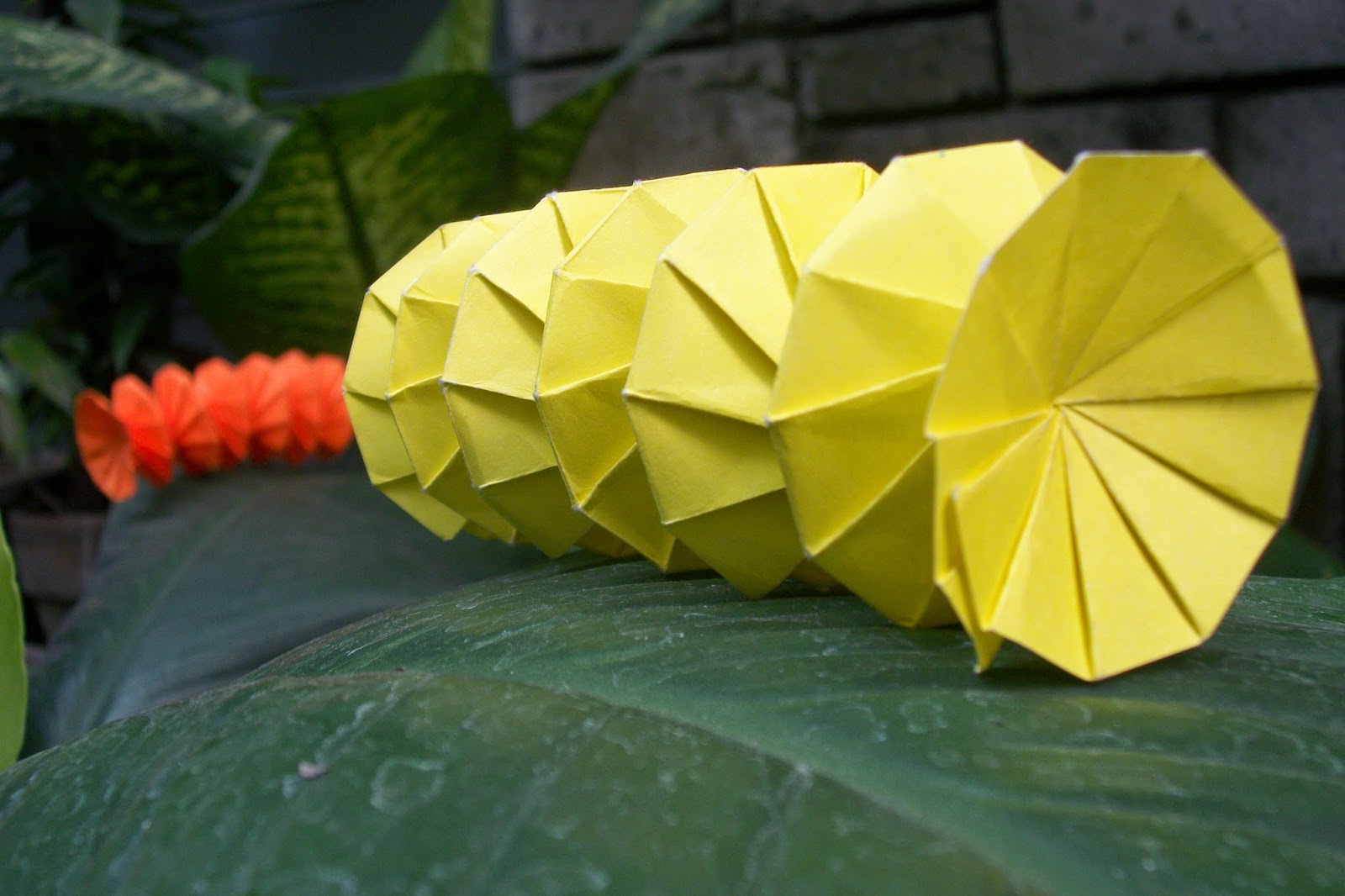
This is designed by Jeff Beynon. Apparently, you can find the instructions all over the Internet, and Fuse's "Let's Fold Spirals."

If you read my first (and annoyingly corny) posts in OAD when I was still in tumblr (I think you know why I switched to blogger), you would surely notice that I criticized this model so much, since before, I always attempted to make this model, but it was too hard so I guess my anger and annoyance took the best of me. But guess what? I SUCCEEDED. :D

Like the crane, it is one of the most famous models over the origami world (though it depends from person to person if he or she knows about it.) Heck, it even had a special place in the origami article of Wikipedia.

This is also one of the "perfectionist" models. Use thin paper, and it will rip up easily, plus it wouldn't shape good. Use thick paper, and it will rip too (plus you'll p**s all over yourself, though that never happened to me). Use the right thick of paper, and you'll get a masterpiece.


Thursday, February 13, 2014

Smart Waterbomb

This is designed/invented by Philip Chapman-Bell. The crease pattern is in http://origami.oschene.com/archives/2010/04/10/again-with-the-smart-waterbomb/ and http://www.origamispirit.com/2010/11/how-to-inflate-the-origami-windmill-or-smart-waterbomb/ .

This model is pretty simple, but as origami artists put it, "simple does not mean easy." You got that crap right.

It is made from a circular piece of paper. So, in making this model, make sure you've got a nice compass nearby or else your work will just become a mere snowball/brain/abstract sculpture thingy at the end.

You also have to make curved creases (to obtain the egg-like shape) and these creases should be PERFECT. But, don't worry, the edge of the paper will guide you. How? I won't tell, just look at the links above.

At the end, you can stick a stick (what) up the bottom of the model. Then, you blow on it like it is a windmill. It spins really fast, so do not use a pointy stick or else it will literally drill through the effing paper and waste the hard work you have put through (unless you forced another one to make it for you).


Monday, December 23, 2013

Pentagonal Shape

This is designed by Andrea Russo. You can visit her page at http://www.flickr.com/photos/9874847@N03/with/5938545126/
There are no available diagrams of this model yet. I just reverse-engineered this thing from the photo. I was surprised I was able to make it since I’m super terrible at reverse-engineering models from the photos.
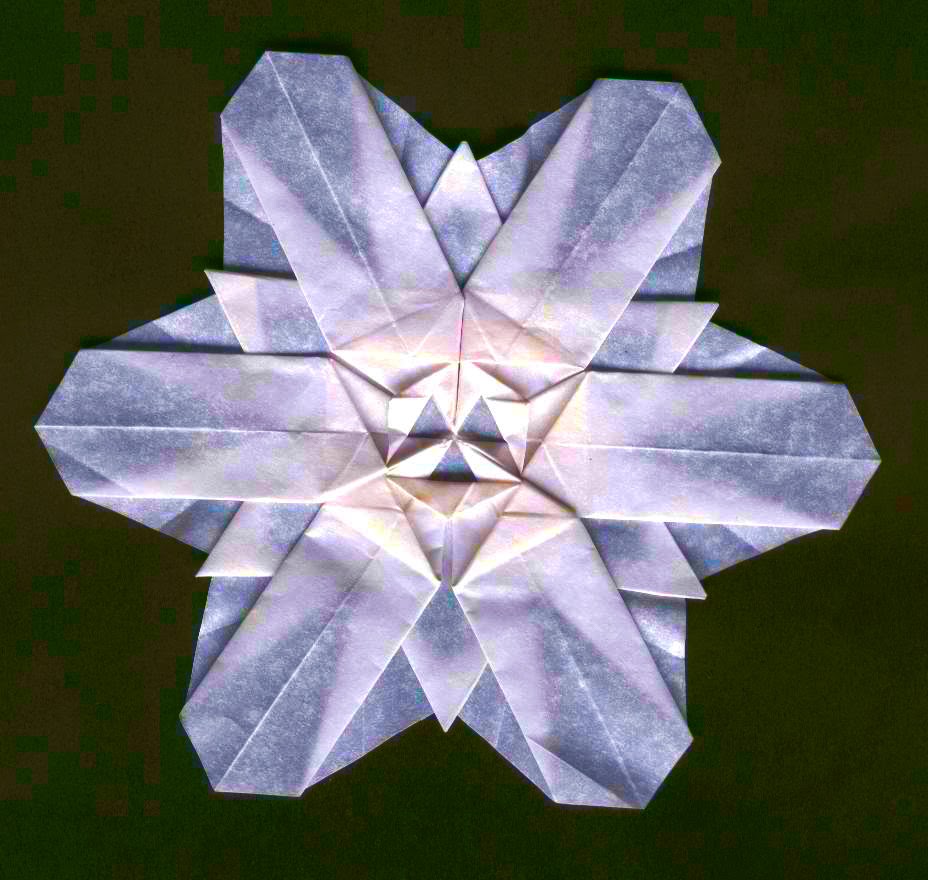
I think it can be considered as a recursive tessellation, like the hydrangea, since the same shape keeps appearing smaller and smaller in the middle.
There is one little problem with this model……Remember that you can make a pentagon out of a hexagon simply by folding 2 points together? Yes, but it will not be a flat model….it will form a cone. But, once you let go, the model will become flat again. That is the problem with Russo’s design.
But, if the right (strong and thick) paper is used, your hard works will be rewarded by this:
image
OFF TOPIC STATEMENT: For all those who have prayed and helped for the recovery of the victims of Typhoon Haiyan (local: Yolanda) which have devastated my beloved country, THANK YOU VERY MUCH! Your kindness will forever be written in the hearts of the victims of this devastating Typhoon. <3

Modular Ball

This is a splendid model by Fumiaki Kawahata.
Although it only needs 6 pieces of paper (yeah, I somehow have a fetish for modulars), the assembly is so freaking hard.
Well, first of all, there are NO locks to hold the pairs together. See those finger-like parts of the module in the picture? They are the ONLY ones that hold the ball together. Second, a simple twist of a module will send the ball into an explosion, just like the Big Bang Theory in the origami world. But, instead of useful stuff coming out of the egg, we get some C-shaped modules that I’m SURE you would not hesitate to throw them into the ocean.
Some origami can try to kill our freaking patience, but sometimes it can be also very rewarding. The ball is surprisingly very sturdy. I threw the freaking ball of paper to my friend for like 5 times, and still, the ball did not break. :D Nice model, overall.
imageThe ball, to me, resembles something, and that is a big ball of dumb caterpillars who have an IQ of only -7 trying to get free.
Here are the diagrams: http://thebraid.files.wordpress.com/2007/08/web_kawahata_ball_steps.jpg
Yeah…..luckily the diagrams weren’t abolished like that of the Jitterbug and the 60-Degree Star…

Espiral

This is a very famous model designed by one of the greatest origami artists
in the colorful origami world, named Tomoko Fuse.

Whenever I see it, Ice cream comes into my mind. It is cute anyhow.
It is made by twisting 4 pieces of triangular paper

image
mmm….Ice cream…..
Anyway, It is not hard as the “Spring Into Action” origami by Jeff Beynon. When I made that model it was so hard I actually ripped the paper into many shreds. I will make that “Spring Into Action” again some day………in the future of man……..or probably not :P (no offense to the designer please).
Anyway, If you want to create one of your own, just visit this link. :D
http://www.youtube.com/watch?v=-Pmr2fdt_ms

Related Posts Plugin for WordPress, Blogger...