Showing posts with label Flower. Show all posts

Saturday, August 15, 2015

Pentagonal Rose

Name
Pentagonal Rose
Designer
Naomiki Sato (さと  なおみき)
Level of Difficulty (5x ☻= hardest)
Type (According to Number of Sheets Used)
Single-sheet
Type (According to Object being Presented)
Flower
Diagrams
Video Tutorial


I must say...this model really destroyed my fingers before I totally got the hang of it. It took me a thousand tries before I noticed that the mistake I keep on making that led to disasters is actually very obvious and dumb. But, once I was able to get the hang of it, I could not help but make more.

This origami rose really captivated my attention because this model looks more realistic than most of the other rose models (though there might be something more realistic out there). It even comes with this five-point calyx with a conical tab which fits into a hole at the bottom of the flower.

(Did you make this flower? Post it on Yey!Origami's Facebook page!)

-ABonymous

Tuesday, December 30, 2014

Flower Tower

This is a design by Chris Palmer. Jeremy Shafer posted a tutorial of this model on Youtube with the teacher being Chris Palmer himself.

Do you experience situations where you do not have the required size of paper for a model so you just have to be content about using a smaller sheet and therefore having a smaller-than-normal product? That is what I felt...The model really consumes paper when it comes to size and I only have a square piece at least 8.5 inches on each side. I really needed the metal stick mail opener I bought from S. Korea to finish the top layer.


If you want a model with many more layers, it's best to use paper with dimensions 12 inches x 12 inches or larger. Just imagine the 8.5 inch x 8.5 inch paper I used shrunk to a mere approximately 2 inches of diameter.

The usual Flower Tower starts from a dodecahedron base (the paper can still be square) but there are other versions, with models folded from octagon-based folds, and even hexagon and pentagon bases.

What stands out with this model is that it has different firework-like layers than can jut out and flatten when folded correctly. It is not an easy model, though. The squishing of the cylinder-like structure midway through the  process can also be difficult unless the folds were done accurately or properly.

Happy New Year!

-ABonymous-

Saturday, December 20, 2014

Flower For Rose

5


This is the "Flower for Rose" designed by Darren Scott with diagrams found in "Everything Origami" (Matthew Gardiner). In my place it is somehow reminiscent of a type of Capiz-made lanterns (Capiz lanterns are shaped like stars supplied with lights that blink with a light interval, forming different light patterns). It is also somehow almost a common design in greeting cards.

Happy Holidays!

-ABonymous-

Friday, February 14, 2014

Geometric Flower

Happy Valentines Day! :D Well, for this day you would think that I would post a heart model, right? WRONG!!!!! Posting hearts is too mainstream. XD But i'll post one later.....

Going on with the topic, this model is designed by Francesco Guarnieri. You may find the crease pattern at http://www.flickr.com/photos/f_guarnieri/5646264173/in/set-72157622572163478/ and http://guarnieri-origami.blogspot.it/2013/01/fiore-geometrico.html .

Note that you will be following a crease pattern, not some bunch of diagrams. Just try to follow which one are the valley and mountains while staring at the picture of the moel Guarnieri posted on flickr.

If you do the crease pattern right, you will get a nice chubby flower. :)


Happy Valentines day!!!!


Thursday, December 26, 2013

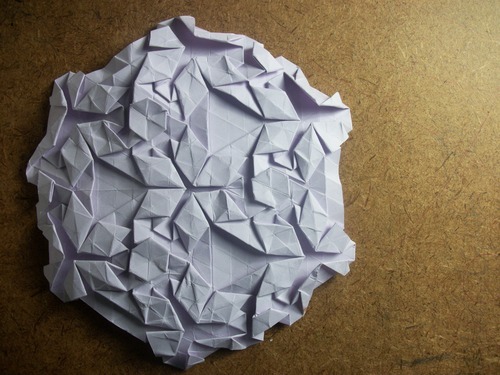
Flowering Grid Tessellation

This is designed by Eric Gjerde. It is also found in his book "Origami Tessellations" (In the cover and in the gallery at the end) but there are no instructions. I just reverse-engineered this from the pictures.

SOMETIMES tessellations are the easiest to reverse-engineer as long as you know the basics. This tessellation basically needs 120-degree pleat intersections and triangle twists.

So, why did Gjerde use a tessellation which does not have a diagram in the book as the book's signature cover? Meh, I dunno.

The Flowering Grid Tessellation and the Daisy Chains Tessellation are a little similar, considering both tessellations are supposed to depict flowers connected by something.

This tessellation is great for beginners, since it does not use any offset creases, plus the techniques used in this model are technically easy; just use a proper triangle grid. You just have to learn how to reverse-engineer.

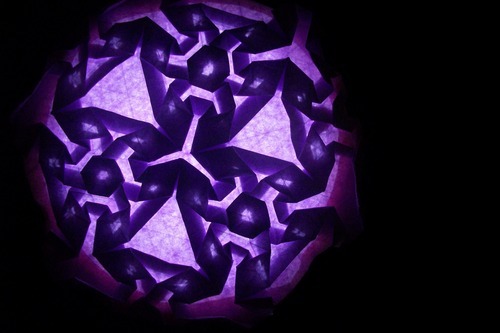
It also looks great backlighted:


I encourage you to learn to reverse-engineer from pictures (tessellations without offset creases are the easiest) since you don't have to find the instructions for a model (tessellation). Other subjects can be very hard though. I've only done a tessellation.

Monday, December 23, 2013

Rhombic Flowers Tessellation

This is designed by Eric Gjerde, though when he made the crease pattern, he wasn’t able to make the tessellation itself yet.The first time I saw the tessellation finished was the Elephant-Hide model by Sara Adams (happyfolding).
This tessellation is a little hard to create. It is one of the complicated (but intermediate) tessellations by Gjerde, yet the crease pattern cannot be found in the book.
Instead, it is found in Gjerde’s website: http://www.origamitessellations.com/2009/08/rhombic-flowers/

The tessellation is composed of flowers created by rhombi (duh) and stars created by hexagons (formed by 3 60-degree pleat intersections) and some triangle-like paper formed by 2 rhombi.
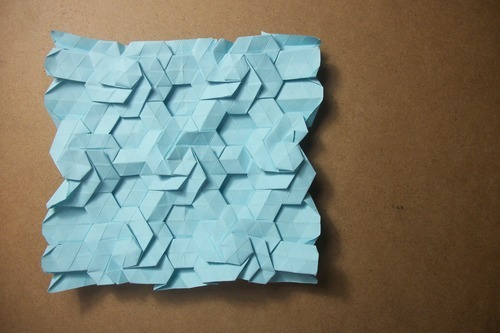
The pictures above are models created from a 32 x 32 grid, but the diagrams have a 64 by 64 grid.The model looks complicated but for me, I would say that the difficulty is intermediate.
I have also done the tessellation in tracing paper, but it was a lot harder than folding construction paper…….tracing paper can be crappin’ stubborn.

Daisy Chains Tessellation

This is designed by Eric Gjerde. The diagrams/crease pattern can be found in his book “Origami Tessellations.”
When I saw first this tessellation, I was like, “oh wow! So beautiful!" but when I saw the crease pattern in the book (which uses a 64 by 64 grid) I was like, "oh crap.”
But then, I thought, “what would it look like when I use a 32 by 32 grid?” and so, I got the tessellation in the picture below.
In the book, it is labelled as “intermediate”. The way it is tilled is very similar to the “Star Twist” Tessellation I featured months ago, but this model is more complicated. Tilling the flower can be a bit complicated, but the end result is worth it.
image
In the book, it is one of the few tessellations which does not have a “back-lighted” photo in the book. I do not know why, but I’m not supposed to care about it much either. Anyway, it looks beautiful when back-lighted.
image

Crossflower

This is my design.
I remember making this for a friend during an earlier flood (not the same flood as the one I stated in the “Five-and-Four Tessellation) but then the bastard lost it.
Wow, what a waste.
Anyway, I wasn’t able to make the model for many years until when I learned that designing an origami model can raise your credibility as an origami artist or something like that.
Luckily, I was able to reproduce the steps, an now, It is already A LITTLE famous.
image
I haven’t made the diagrams, but when I do, I will surely post it in this blog.
It’s easy to reverse-engineer it from the picture, though.

Sternblute

This is a well-known model created by another genius in the world of origami. Her name is Ms. Carmen Sprung.
Somehow, you can also manipulate the number of units, just like the TSU, but there are some limits.

1) The range of units are from 5 to 8.
2) You can only create a star which somehow becomes more 3-D when you lessen the number of units.

The English translation of “Sternblute” (it’s in German) is Starflower, even if the 8-unit version only looks like it and the thing looks more like a miniature wormhole about to suck you up and spit you out in another dimension.
There’s another name for it, and it’s Sterntaler. I do not know what it means, so let’s pretend its the name of a spaceship about to do a cartwheel in the black void of freaking space.
image

The diagrams can be found in this link: http://www.papierfalten.de/documents/faltanleitungen/8er_sternbluete.pdf

There are also diagrams in Sprung’s book “Origami: 21 Sterne,” yet the price was higher than a man who smoked marijuana, peyote, and any other illegal drug combined.
Such a pity, it really is a nice book……oh well.
Related Posts Plugin for WordPress, Blogger...